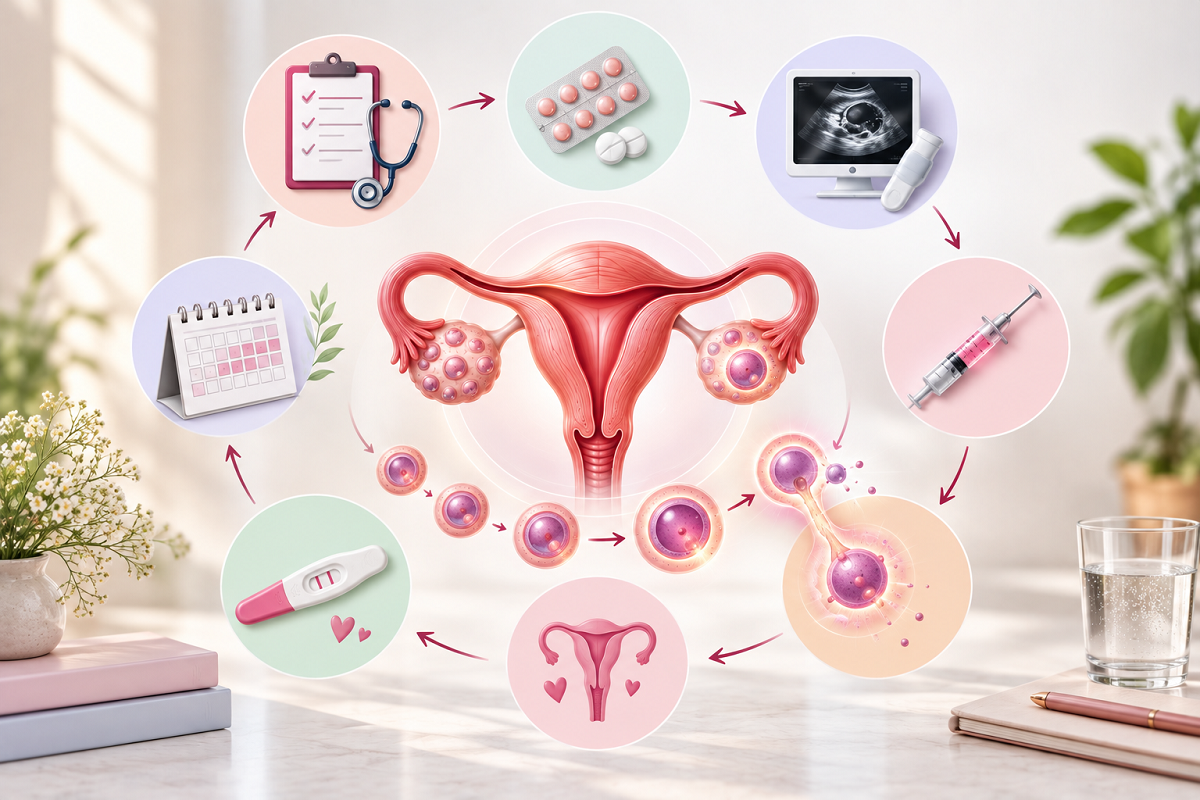
Dr. Ladu Dewasi is a consultant gynaecologist and infertility specialist practising at Mayflower Women’s Hospital, Bopal-Ambli, Ahmedabad. His approach to ovulation induction focuses on individual response rather than a fixed calendar-based protocol, with follicular tracking ultrasounds used to guide medication, dose adjustments and timing.
Depending on the fertility factors involved, the cycle may be followed by timed intercourse or Intrauterine Insemination (IUI).
Ovulation induction may be considered when you have:
If you have been trying to conceive for 12 months without success and are under 35, or for 6 months if you are 35 or older, a fertility evaluation is generally recommended. Earlier assessment is appropriate when periods are very irregular or absent, or when another known fertility concern is present.
Some signs are well known; others can be overlooked because they do not always feel like a fertility problem:
There is no single medication sequence that is right for every patient. The choice depends on the cause of ovulatory dysfunction, other fertility factors, previous treatment response, age and the treatment goal.
Gonadotropins may be used when oral treatment has not produced an adequate response or when a more controlled stimulation approach is appropriate. Because injectable stimulation can lead to multiple developing follicles, it generally requires careful ultrasound monitoring and dose adjustment.
When monitoring shows that a leading follicle or follicles have reached an appropriate stage of maturity, a trigger injection may be used to help coordinate ovulation timing. A commonly used follicle size is around 18-20 mm, but the decision depends on the overall treatment protocol and ultrasound findings rather than size alone.
Medication stimulates follicle development, but monitoring helps determine how your ovaries are actually responding. Ultrasound monitoring may be used to assess:
Book a consultation with IVF experts Dr Ladu Dewasi in Ahmedabad.
There is no single success percentage that applies to every patient. Outcomes depend on factors such as:
For women with PCOS-related anovulatory infertility, Letrozole is supported as the preferred first-line pharmacological option when no other infertility factors are present.
How long to continue ovulation induction depends on the individual situation. In some patients, treatment is assessed over several monitored cycles; in others, age, ovarian reserve, semen results, tubal factors or poor response may justify changing the plan sooner. The important question is not simply the number of cycles, but whether the treatment is producing an appropriate response and whether it remains the most suitable option.
Ovulation induction may be used as a standalone treatment or as part of a broader fertility plan.
The goal is not to delay advanced treatment unnecessarily, but to choose the least complex approach that is appropriate for your age, diagnosis and overall fertility picture.


Mayflower Women’s Hospital – 2nd Floor, Satyamev Elite Ambli, Junction, Sardar Patel Ring Rd, Bopal, Ahmedabad, Gujarat 380058
