What Should You Bring to a First Fertility Consultation?
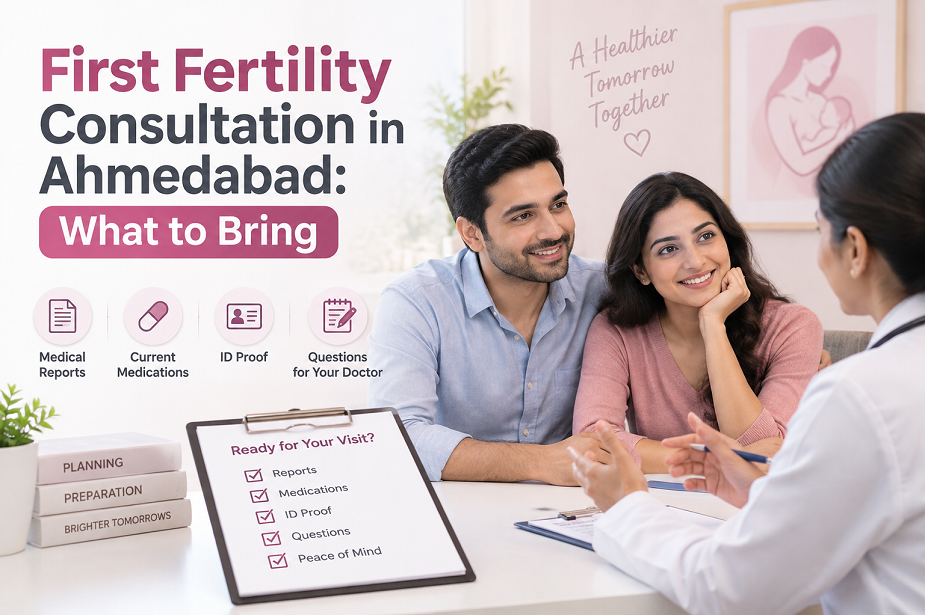
Bring both partners, photo ID for each, your menstrual cycle dates for the last six months, every previous test report and scan (including old ones), a list of all medicines and supplements you take, details of any past surgery or pregnancy, and your marriage certificate if you may proceed to IVF or IUI.
Most couples arrive at a first fertility appointment carrying a folder of reports they don’t fully understand and a question they’re slightly afraid to ask out loud. That’s normal. This visit is not a verdict. It is an information-gathering session, and how much useful information you leave with depends substantially on what you walk in with.
Infertility is common. The World Health Organisation estimates that roughly one in six adults of reproductive age worldwide is affected by it at some point. Clinically, infertility is defined as the failure to conceive after twelve months of regular unprotected intercourse or after six months if the female partner is aged 35 or older. India’s Assisted Reproductive Technology (Regulation) Act, 2021 uses the same twelve-month definition for couples seeking treatment.
This guide covers what to bring, what happens during the consultation, and the one timing detail that can save you an entire month.
The Short Checklist
Both partners attend. Roughly 40–50% of cases involve a male factor. A consultation with only one partner present is half a consultation.
Documents
- Photo ID for both partners (Aadhaar, passport or driving licence)
- Marriage certificate required under the ART Act, 2021 if you proceed to IUI, IVF or ICSI
- Any insurance or employer health scheme details
Medical records bring everything, even if it looks old or irrelevant
- All previous blood test reports (hormones, thyroid, sugar, vitamin D, haemoglobin)
- All ultrasound reports and, where possible, the scan images or CDs
- Any previous semen analysis report
- Reports from any earlier fertility treatment: ovulation induction cycles, IUI, IVF, including drug names and doses used
- Hysterosalpingography (HSG), hysteroscopy or laparoscopy reports
- Discharge summaries from any abdominal or pelvic surgery
- Any genetic or karyotype testing already done
Your own notes
- Menstrual cycle dates for the last six months: first day of bleeding each month, cycle length, flow, pain
- How long you have been trying to conceive, and whether intercourse is timed
- Full list of medicines, supplements and any Ayurvedic or homoeopathic preparations, with doses
- Previous pregnancies, miscarriages, ectopic pregnancies or terminations, with dates and gestational age
- Family history of diabetes, thyroid disease, PCOS, early menopause, recurrent miscarriage or genetic conditions
- Smoking, alcohol, tobacco or gutkha use for both partners, stated honestly
The timing details almost nobody mentions
If you can choose your appointment date, aim for day 2 to day 5 of the menstrual cycle, counting day 1 as the first day of proper bleeding.
The reason is practical. The baseline hormone panel that anchors a female fertility assessment FSH, LH and estradiol is only interpretable when drawn in the early follicular phase. The antral follicle count, which is done on transvaginal ultrasound to estimate ovarian reserve, is also most accurate in that same window.
Attend day 2 to 5, and the consultation, scan, and blood draw can happen in a single visit. Attend on day 18, and you will likely be asked to return at the start of your next cycle for those specific tests, which add three to four weeks to the process.
Two things that do not need cycle timing: AMH (anti-Müllerian hormone), which can be drawn on any day, and semen analysis, which follows its own preparation window.
If you are already at day 20 and anxious to be seen, come anyway. There is plenty to assess, discuss and plan. Just know that one or two tests may need a repeat visit.
Semen Analysis: Prepare before you arrive
The male partner should observe two to seven days of sexual abstinence before producing a sample. Fewer than two days lowers volume and count; more than seven days lowers motility. Both distort the result.
This matters because the numbers are compared against published thresholds. The WHO laboratory manual, sixth edition (2021), sets lower reference limits of 1.4 mL semen volume, 16 million sperm per millilitre, 39 million total sperm per ejaculate, 42% total motility, 30% progressive motility and 4% normal morphology.
A result below one of those limits is not a diagnosis of infertility. Those limits represent the 5th percentile of a reference group of men whose partners conceived naturally within twelve months, meaning some men who fathered children fell below them. A borderline report is a reason for a repeat test, usually after two to three weeks, not a reason to panic.
What happens during the consultation
History taking
The longest and most valuable part. Expect detailed questions about menstrual pattern, previous pregnancies, pelvic pain, discharge, weight change, acne, excess hair growth, past infections, surgery, medication, occupational exposures and lifestyle. The male partner is asked about past illness, mumps after puberty, undescended testis, groin or hernia surgery, injury, heat exposure at work, and medication including anabolic steroids or testosterone supplements.
General examination
Height, weight, BMI, blood pressure, thyroid examination, and a check for signs of hormonal imbalance such as acanthosis nigricans or hirsutism.
Pelvic examination and ultrasound
A transvaginal ultrasound assesses the uterus, endometrial lining, both ovaries and the antral follicle count. This also picks up fibroids, polyps, endometriomas and the polycystic ovarian morphology relevant to a PCOS diagnosis. The scan is brief and does not require anaesthesia.
Review of your existing reports
This is where the folder earns its keep. An AMH from eight months ago, an HSG from two years ago, a semen analysis from another city all of it reduces duplicate testing.
Discussion and a written plan
You should leave with a clear understanding of what is being investigated, which tests come next, when in your cycle each one is scheduled, and what the realistic options look like. If you do not leave with that, ask before you leave.
Tests commonly ordered after a first consultation
| Test | When in the cycle | What it assesses |
| FSH, LH, estradiol | Day 2–5 | Baseline ovarian function |
| AMH | Any day | Ovarian reserve |
| Antral follicle count (TVS) | Day 2–5 | Ovarian reserve |
| TSH, prolactin | Any day | Thyroid and pituitary causes of anovulation |
| Fasting glucose, HbA1c, insulin | Any day, fasting | Insulin resistance, often with PCOS |
| Vitamin D, B12, haemoglobin | Any day | Correctable deficiencies |
| Semen analysis | After 2–7 days of abstinence | Male factor |
| Follicular monitoring scans | Day 9 onward | Whether and when ovulation occurs |
| HSG or sono-salpingography | Day 6–10, after bleeding stops | Fallopian tube patency |
| Hysteroscopy/laparoscopy | Case by case | Uterine cavity and pelvic pathology |
Not every couple needs every test. A 26-year-old with regular cycles trying for thirteen months needs a different workup from a 38-year-old with two previous miscarriages.
Questions worth asking
Write these down and bring them. You will forget them otherwise.
- Based on my history, what are the most likely causes in my case?
- Which tests are you ordering, and what will each one tell us?
- How long will the full assessment take before we have a plan?
- Do we start with timed intercourse, ovulation induction, IUI or IVF and why that one first?
- Given my age and reports, what is a realistic expectation?
- How many cycles of this approach before we reconsider?
- What can I change in the meantime that genuinely affects the outcome?
- What do I do if something feels wrong between appointments?
Three things that are not your fault
A first consultation is often when couples finally voice the guilt they have been carrying. Worth stating plainly:
Stress does not cause infertility. Infertility causes stress. The causal arrow is reversed in most well-meaning advice you have been given.
A previous termination or miscarriage rarely causes later infertility. Where a problem exists, it is usually a specific, identifiable complication, not a general penalty.
Delaying conception for career or circumstance is not negligence. Age affects egg quality and quantity, which is a biological fact worth planning around, not a moral failing to be apologised for.
Practical notes for the Bopal Centre
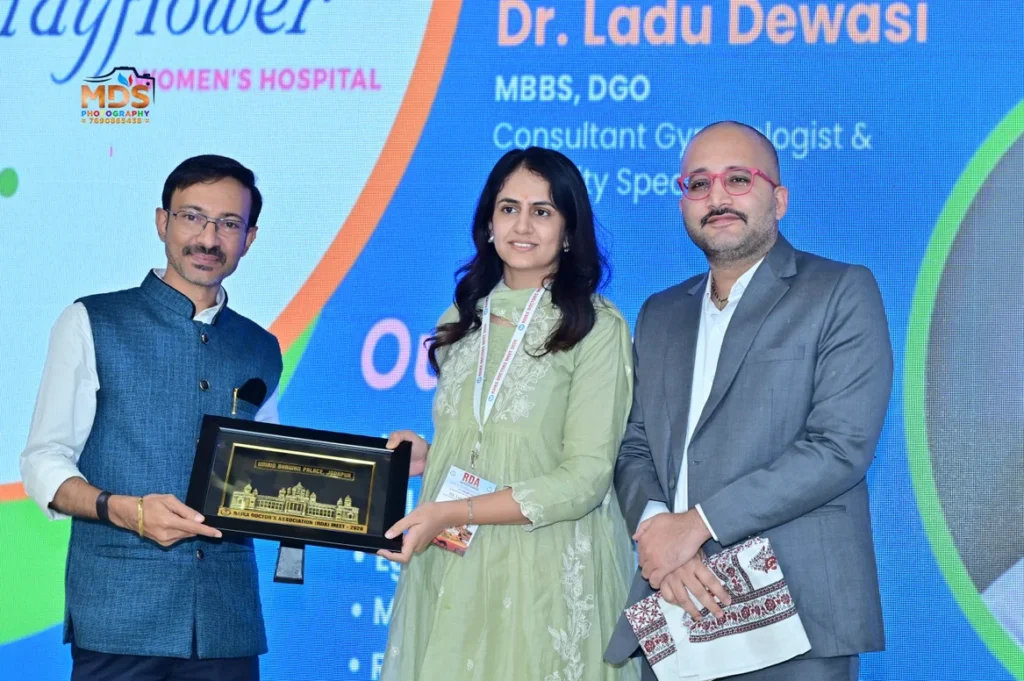
Dr. Ladu Dewasi consults at Mayflower Women’s Hospital, Bopal – 2nd Floor, Satyamev Elite, Bopal–Ambli Junction, Sardar Patel Ring Road, Ahmedabad 380058.
The Bopal centre is an OPD and consultation facility with on-site laboratory, pharmacy and anaesthesiology support. Consultation, ultrasound and blood sampling happen here. Procedures requiring day-care or inpatient admission, including egg retrieval and minimally invasive surgery, are carried out at Mayflower’s Memnagar hospital, with the referral coordinated for you.
Appointments are recommended rather than walk-ins, so the right investigation can be scheduled for your cycle day. Call +91 99097 16716 to book.
A note on eligibility, since couples often ask, under the ART Regulation Act, 2021, ART services in India are provided to married couples where the woman is above 21 and below 50 and the man is above 21 and below 55. This is why identity and marriage documents are requested at the point of starting treatment rather than at a first consultation. (Several High Courts have granted relief in individual cases outside these limits; that is a matter for legal advice, not clinical advice.)
About the author
Dr. Ladu Dewasi is a Consultant Gynaecologist and Fertility Specialist at Mayflower Women’s Hospital, Ahmedabad, with over seven years of experience in reproductive medicine, gynaecology and obstetrics. She holds an MBBS and an MD in Anaesthesia, completed a fellowship at Mayflower Hospital, and has previously practised at CIMAR and Aster Hospital in Kochi. Her practice covers infertility assessment, ovulation induction, PCOS, IUI, IVF and ICSI, recurrent pregnancy loss and fertility preservation.
Ready to start? Book a first fertility consultation with Dr. Ladu Dewasi at Mayflower Women’s Hospital, Bopal.
Book an Appointment · Call +91 99097 16716
FAQs
What should I bring to my first fertility consultation?
Bring photo ID for both partners, your menstrual cycle dates for the last six months, every previous blood test and ultrasound report, any earlier semen analysis, records of previous fertility treatment or surgery, a complete list of medicines and supplements, and your marriage certificate if you may proceed to IUI or IVF.
Should both partners attend the first appointment?
Yes. A male factor contributes to roughly 40 to 50 per cent of infertility cases, so both partners are assessed from the start. Attending together also means the history, the findings and the plan are heard the same way by both of you.
Which day of my cycle is best for a first fertility consultation?
Day 2 to day 5 of the menstrual cycle is ideal, because the baseline FSH, LH and estradiol blood tests and the antral follicle count on ultrasound are only accurate in that window. Booking then can compress the consultation, scan and blood work into one visit.
How long does a first fertility consultation take?
Allow 45 to 60 minutes for the consultation itself. If an ultrasound and blood sampling are done the same day, plan for closer to 90 minutes at the centre.
Do I need to be fasting for my first fertility appointment?
Come fasting if you can, ideally 8 to 10 hours. Several commonly ordered tests fasting glucose, insulin and lipid profile require it, and arriving fasted avoids a second trip. Water is fine.
How should my husband prepare for a semen analysis?
He should abstain from ejaculation for two to seven days before the sample. Less than two days reduces volume and count; more than seven days reduces motility. He should also mention any fever in the preceding three months, since that can temporarily affect the result.
When should a couple see a fertility specialist?
After twelve months of trying without conceiving, or after six months if the female partner is 35 or older. See a specialist sooner without waiting if there are irregular or absent periods, known PCOS or endometriosis, previous pelvic surgery or infection, two or more miscarriages, or a known male factor.
Will I need an internal examination at the first visit?
Usually a transvaginal ultrasound is performed, as it gives the clearest view of the uterus and ovaries. It takes a few minutes, needs no anaesthesia, and can be deferred or replaced with an abdominal scan if you prefer tell the doctor.
Do I need a referral to see a fertility specialist in Ahmedabad?
No. You can book a fertility consultation directly. Bringing records from any doctor you have already seen is helpful, but a formal referral letter is not required.
What happens after the first consultation?
You receive an investigation plan with each test mapped to a specific cycle day. Once the results are in, usually across one menstrual cycle, a follow-up visit establishes the diagnosis and the treatment options, from timed intercourse and ovulation induction through IUI to IVF or ICSI.