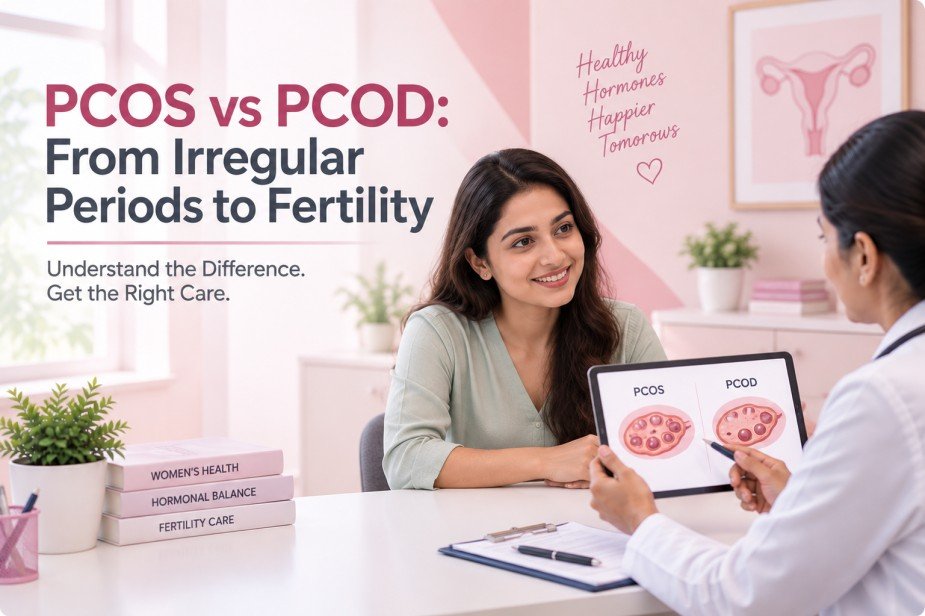
Irregular periods, sudden weight changes, acne, unwanted facial hair or difficulty getting pregnant can make you wonder: Is it PCOS or PCOD?
These two terms are often used interchangeably, but there is an important difference to understand. PCOS (Polycystic Ovary Syndrome) is the recognised medical condition, while PCOD (Polycystic Ovarian Disease) is a term still commonly used by patients and in everyday conversations.
What matters most is not just the name, but understanding what is happening with your hormones, periods and ovulation—and whether it is affecting your overall health or fertility.
If your periods have become irregular or you are trying to conceive, a proper evaluation can help identify the cause and guide the right treatment.
PCOS vs PCOD: Are They Really Different?
PCOS is a well-established hormonal and metabolic condition. PCOD is not considered a separate standardised diagnosis in current medical guidelines, although the term is still widely used.
PCOS can affect:
- Ovulation
- Menstrual cycles
- Androgen hormone levels
- Skin and hair
- Metabolic health
- Fertility
You may hear someone say they have “PCOD” after an ultrasound shows multiple small follicles in the ovaries. However, an ultrasound alone cannot diagnose PCOS.
Having multiple follicles does not automatically mean you have PCOS. Similarly, PCOS does not mean that you have large ovarian cysts that need to be removed.
A proper evaluation considers your menstrual history, symptoms, clinical findings and appropriate investigations together.
Why Do PCOS and PCOD Get Confused So Often?
The confusion often starts with the word “cyst.”
Many women are told that PCOS means they have cysts in their ovaries. This is not quite accurate.
In some women with PCOS, the ovaries may have a polycystic appearance on an ultrasound, with many small follicles. These differ from the ovarian cysts people commonly think of as growths or fluid-filled sacs.
PCOS is a broader condition involving hormonal and ovulatory changes.
So, if your ultrasound report says, “polycystic ovarian morphology”, it does not automatically mean you have PCOS. Your symptoms and overall clinical picture are also important.
PCOS vs PCOD Symptoms: What Should You Look For?
The symptoms can overlap, which is another reason these terms are often confused.
Some women may experience:
- Irregular or missed periods
- Long gaps between periods
- Difficulty predicting ovulation
- Acne or oily skin
- Increased facial or body hair
- Hair thinning on the scalp
- Weight gain or difficulty managing weight
- Darkening of the skin around the neck or underarms
- Difficulty conceiving
However, no single symptom can confirm PCOS.
For example, irregular periods can also happen because of thyroid problems, high prolactin levels, significant weight changes and other hormonal or reproductive conditions.
That is why persistent changes in your menstrual cycle should be evaluated rather than self-diagnosed.
Irregular Periods: The First Sign Many Women Notice
For many women, the first sign that something may be wrong is their period.
You may notice that:
- Your periods arrive several weeks late.
- You skip periods for one or more months.
- Your cycle becomes difficult to predict.
- You have fewer periods than you used to.
- Your periods suddenly become irregular.
Irregular periods can be a sign that ovulation is not happening regularly.
This becomes particularly important if you are planning a pregnancy because regular ovulation plays an important role in natural conception.
If you are experiencing persistent irregular periods, a gynaecology consultation can help determine whether PCOS or another condition is contributing to the problem.
How Does PCOS Affect Fertility?
PCOS can affect fertility mainly by interfering with regular ovulation.
If ovulation happens infrequently or unpredictably, it becomes more difficult to identify the fertile window. In some women, ovulation may not happen regularly at all.
But this does not mean that pregnancy is impossible.
Many women with PCOS conceive naturally. Others may need treatment to help support regular ovulation.
The important question is not simply:
“Do I have PCOS?”
It is:
“Is PCOS affecting my ovulation, and are there any other factors affecting fertility?”
The answer can make a significant difference to the treatment plan.
Does PCOS Mean I Will Need IVF?
No.
Having PCOS does not automatically mean that you need IVF.
If irregular or absent ovulation is the main fertility problem and there are no other major infertility factors, treatment may begin with:
- Lifestyle and metabolic health management
- Ovulation induction
- Ovulation monitoring
- Timed intercourse
- IUI when appropriate
- IVF when clinically indicated
For women whose main fertility problem is PCOS-related ovulation difficulty, ovulation induction may be considered before moving to more advanced fertility treatment.
The right approach depends on factors such as your age, ovarian reserve, ovulation pattern, duration of infertility, partner’s fertility evaluation and previous treatment.
This is why a proper infertility assessment is often more useful than assuming IVF is necessary.
PCOS, PCOD and Pregnancy: What Should You Know?
If you have PCOS and want to become pregnant, the first step is understanding whether you are ovulating regularly.
If ovulation is irregular, your doctor may recommend cycle monitoring and medication to support ovulation.
Some women conceive naturally once their ovulation becomes more regular. Others may need fertility treatment.
A fertility evaluation may also look at other factors, including:
- Ovarian reserve
- Fallopian tubes
- Uterus
- Sperm count and motility
- Age-related fertility changes
- Previous pregnancy or miscarriage history
This is important because fertility is a couple-level issue. PCOS should not automatically be assumed to be the only reason pregnancy has not happened.
How Is PCOS Diagnosed?
There is no single blood test that confirms PCOS in every woman.
Your doctor may consider several factors.
1. Menstrual History
Your doctor may ask:
- How often do your periods occur?
- How long are your cycles?
- Have you started missing periods?
- When was your last period?
- Have your periods changed recently?
Keeping track of your menstrual cycle can be very helpful during a consultation.
2. Symptoms and Clinical Examination
Your doctor may ask about acne, unwanted hair growth, scalp hair thinning, weight changes and other signs of hormonal imbalance.
Other health factors may also be assessed based on your symptoms and medical history.
3. Blood Tests
Depending on your symptoms, blood tests may be recommended to assess hormone levels or rule out other conditions that can cause similar symptoms.
Your doctor may also recommend tests related to blood sugar and metabolic health when appropriate.
There is no universal “PCOS test package” that every woman needs.
4. Ultrasound
A pelvic ultrasound can assess the uterus and ovaries and may show a polycystic ovarian appearance.
But remember:
An ultrasound alone does not diagnose PCOS.
The result needs to be considered alongside your symptoms, menstrual history and other clinical findings.
Can PCOS Be Managed?
Yes.
PCOS is generally considered a long-term condition, but its symptoms and associated health concerns can often be managed effectively.
Treatment depends on your symptoms and your current goals.
If you are not planning pregnancy:
Treatment may focus on menstrual management, acne, unwanted hair growth, metabolic health and long-term risk reduction.
If you are planning pregnancy:
The focus may shift toward ovulation, fertility evaluation and conception.
If you have metabolic concerns:
Your doctor may assess blood sugar and other relevant health factors.
There is no single treatment that works for every woman. PCOS treatment should be tailored to your symptoms, health and reproductive goals.
Does Weight Always Cause PCOS?
No.
PCOS can affect women of different body sizes.
Some women with PCOS gain weight or find weight management difficult, while others do not have these concerns.
This is important because PCOS management should not simply be reduced to “just lose weight.”
A balanced diet, regular physical activity, adequate sleep and sustainable lifestyle habits can support metabolic and reproductive health. But treatment should always be based on the individual woman rather than her weight alone.
When Should You See a Gynaecologist?
Consider seeing a gynaecologist if you have:
- Persistent irregular or missed periods
- Long gaps between menstrual cycles
- Excess facial or body hair
- Acne along with menstrual changes
- Unexplained weight changes
- Hair thinning
- Difficulty predicting ovulation
- Difficulty conceiving
- A previous PCOS diagnosis
- An ultrasound report showing polycystic ovarian morphology
You do not have to wait until you are trying for a baby to address PCOS symptoms.
Early evaluation can help you understand what is happening and whether you need treatment or regular monitoring.
PCOS vs PCOD: What Should You Remember?
The key point is simple:
PCOS is a recognised hormonal condition. PCOD is a term commonly used for similar symptoms or ovarian findings, but it is not a separate standardised diagnosis in current clinical guidelines.
Instead of focusing only on whether you have “PCOS or PCOD,” ask:
- Are my periods regular?
- Am I ovulating?
- Do I have signs of hormonal imbalance?
- Are there any metabolic concerns?
- Is anything affecting my fertility?
- Do I need treatment or only monitoring?
A proper evaluation can answer these questions much more accurately than an online symptom checklist or an ultrasound report alone.
If You Are Trying to Conceive With PCOS
Do not assume that PCOS means you will need IVF.
The first step is to understand what is affecting your fertility.
An infertility assessment may evaluate ovulation, ovarian reserve, the uterus and fallopian tubes when indicated, along with sperm health.
Depending on the findings, you may need ovulation induction, monitored cycles, IUI, IVF or simply more time trying naturally.
The goal is not to move every woman with PCOS toward advanced fertility treatment.
The goal is to choose the simplest effective treatment for your individual situation.
Take the Next Step with a Personalised Evaluation
If irregular periods, PCOS symptoms or difficulty conceiving are affecting your health or family planning, getting a proper evaluation can give you a clearer understanding of what is happening.
Dr. Ladu Dewasi, Consultant Gynaecologist and Fertility Specialist at Mayflower Women’s Hospital, Bopal, Ahmedabad, provides personalised care for PCOS, ovulation problems and fertility concerns.
If you are experiencing PCOS symptoms or trying to conceive, a consultation can help identify the possible cause and determine the right next step.
Frequently Asked Questions
Is PCOS and PCOD the same?
The terms are often used interchangeably, but PCOS is the recognized medical condition. PCOD is a term still commonly used in everyday conversations.
Can PCOS cause infertility?
Yes. PCOS can make conception difficult when it causes irregular or absent ovulation. Many women with PCOS, however, conceive naturally or with appropriate treatment.
Can I get pregnant naturally with PCOS?
Yes. Many women with PCOS become pregnant naturally. If ovulation is irregular, treatment may help support ovulation.
Does an ovarian cyst mean I have PCOS?
No. A simple ovarian cyst is different from PCOS, and an ultrasound showing multiple small follicles does not automatically confirm PCOS.
Will I need IVF if I have PCOS?
Not necessarily. Depending on your fertility assessment, ovulation induction, monitored cycles, timed intercourse or IUI may be considered before IVF.
About the Author
Dr. Ladu Dewasi is a Consultant Gynaecologist and Fertility Specialist at Mayflower Women’s Hospital, Ahmedabad, with over seven years of experience in reproductive medicine, gynaecology and obstetrics. She holds an MBBS and an MD in Anaesthesia, completed a fellowship at Mayflower Hospital, and has previously practised at CIMAR and Aster Hospital in Kochi. Her practice covers infertility assessment, ovulation induction, PCOS, IUI, IVF and ICSI, recurrent pregnancy loss and fertility preservation.
Ready to start? Book a first fertility consultation with Dr. Ladu Dewasi at Mayflower Women’s Hospital, Bopal.
Book an Appointment · Call +91 99097 16716