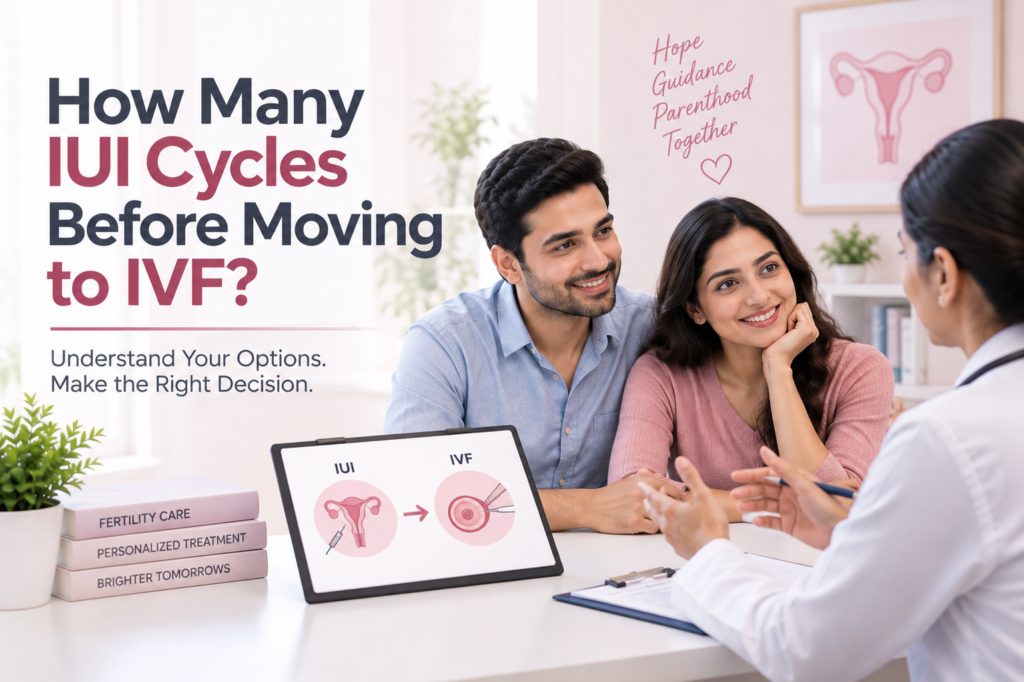
If you are considering IUI, one of the most common questions is: How many IUI cycles should you try before moving to IVF?
There is no single number that is right for every couple. Some couples may conceive after the first or second IUI cycle, while others may need to consider IVF after several unsuccessful attempts.
The decision depends on several factors, including age, cause of infertility, ovarian reserve, sperm quality, fallopian tube health and how you respond to IUI treatment.
Understanding when to continue IUI and when to consider IVF can help you make a more informed fertility treatment decision.
How Many IUI Cycles Should You Try Before IVF?
For many couples, 3 to 4 IUI cycles may be considered before moving to IVF, particularly when the woman is younger and there are no major fertility problems.
However, this is not a fixed rule.
Your fertility specialist may recommend fewer IUI cycles if there are factors that make IUI less likely to work. In other situations, continuing IUI for a little longer may be reasonable.
The goal is not to complete a specific number of IUI cycles. The goal is to choose the treatment that gives you a reasonable chance of pregnancy without unnecessarily delaying more effective treatment.
When Is IUI Recommended?
IUI, or Intrauterine Insemination, is a fertility treatment in which prepared sperm is placed directly inside the uterus around the time of ovulation.
It may be considered in situations such as:
- Unexplained infertility
- Mild male-factor infertility
- Problems with ovulation
- Difficulty having intercourse
- Use of donor sperm
- Certain cervical factors
IUI may also be recommended when medication is being used to stimulate ovulation, and the doctor wants to improve the timing and chances of sperm reaching the egg.
Before starting IUI, your doctor will usually assess whether it is an appropriate treatment for your fertility situation.
How Does IUI Treatment Work?
A typical IUI cycle may involve several steps.
- Ovulation Monitoring
Your doctor may monitor follicle growth using ultrasound to identify when the egg is likely to mature.
- Ovulation Medication
Depending on the situation, medication may be used to stimulate ovulation.
- Trigger Injection
In some cycles, an injection may be given to help time ovulation more accurately.
- Sperm Preparation
A semen sample is processed in the laboratory to select suitable sperm.
- IUI Procedure
The prepared sperm is placed into the uterus using a thin catheter around the time of ovulation.
- Pregnancy Test
A pregnancy test is usually advised after the appropriate waiting period.
The exact protocol can vary from one woman or couple to another.
What Is the IUI Success Rate Per Cycle?
One important thing to understand is that IUI does not guarantee pregnancy in each cycle.
The chance of success depends on factors such as:
- Woman’s age
- Egg quality
- Ovarian reserve
- Sperm count and motility
- Cause of infertility
- Number of mature follicles
- Whether the fallopian tubes are open
- Overall reproductive health
This is why it is better to look at your overall chance across multiple appropriately selected cycles rather than expecting every IUI attempt to result in pregnancy.
When Should You Consider Moving from IUI to IVF?
The decision to move from IUI to IVF depends on your individual circumstances.
Your doctor may recommend considering IVF when:
- Several IUI Cycles Have Failed
If appropriately performed IUI cycles have not resulted in pregnancy, the expected benefit of continuing may decrease.
After several unsuccessful attempts, your fertility specialist may discuss whether IVF could offer a better chance.
- Age Is an Important Factor
Age plays a major role in fertility.
As age increases, egg number and egg quality can decline. This can affect the chances of pregnancy with both natural conception and fertility treatments.
For this reason, a woman in her late 30s or early 40s may not be advised to spend many months repeating IUI if IVF is likely to provide a better chance.
The number of IUI cycles recommended should therefore be considered in the context of age and ovarian reserve, rather than as a fixed number for everyone.
- There Is Significant Male-Factor Infertility
IUI works best when there are enough healthy, motile sperm available after processing.
If the sperm count or motility is significantly reduced, IUI may have a lower chance of success.
In such cases, your doctor may discuss IVF with ICSI rather than continuing multiple IUI cycles.
- The Fallopian Tubes Are Blocked
At least one functioning fallopian tube is generally needed for IUI to have a reasonable chance of working.
If both fallopian tubes are blocked, IUI is not an effective treatment because the sperm cannot reach the egg through the fallopian tube.
In such situations, IVF may be recommended.
- Ovarian Reserve Is Low
If testing suggests reduced ovarian reserve, delaying treatment by repeating many IUI cycles may not always be appropriate.
Your fertility specialist may discuss IVF sooner depending on your age, ovarian reserve and overall fertility picture.
- There Are Other Fertility Factors
Conditions involving the uterus, endometriosis, previous fertility treatment, recurrent pregnancy loss or other reproductive factors may change the recommended treatment pathway.
This is why an infertility assessment is important before deciding how many IUI cycles are appropriate.
IUI vs IVF: What Is the Difference?
IUI and IVF are both fertility treatments, but they work in different ways.
IUI | IVF |
| Sperm is placed inside the uterus | Eggs are collected from the ovaries |
| Fertilisation occurs inside the body | Fertilisation occurs in the laboratory |
| Less invasive | More involved treatment |
| Usually, lower cost per cycle | Usually, higher cost per cycle |
| Generally lower success per cycle | Generally higher success per cycle in appropriate patients |
| May be tried first in selected couples | May be recommended earlier depending on age and fertility factors |
IUI is generally simpler, but IVF provides more control over fertilisation and embryo development.
Your doctor will recommend the option that is most appropriate for your fertility condition rather than choosing one treatment for everyone.
Is IVF Better Than IUI?
Not necessarily.
IVF is more advanced, but “more advanced” does not automatically mean it should be the first treatment.
If you are younger, have unexplained infertility or mild male-factor infertility, open fallopian tubes and a reasonable ovarian reserve, IUI may be a sensible first step.
However, if there are factors that significantly reduce the likelihood of IUI success, moving directly to IVF may save valuable time.
The right question is not:
“Which treatment is better?”
It is:
“Which treatment gives me a reasonable chance of pregnancy based on my fertility profile?”
How Age Affects the Decision to Move from IUI to IVF
Age is one of the most important factors when deciding how long to continue with IUI.
IUI in Younger Women
For younger women with a good ovarian reserve and no major fertility problems, several IUI cycles may be reasonable.
If pregnancy does not occur after a few well-timed attempts, IVF can then be discussed.
IUI in Women Over 35
After 35, fertility gradually declines, and the decline becomes more significant as age increases.
Because time becomes more important, your fertility specialist may recommend a shorter trial of IUI before discussing IVF.
IUI in Women Over 40
For women over 40, repeating many IUI cycles may not be the most effective strategy in some situations.
The decision may depend heavily on ovarian reserve, egg quality, sperm factors and the overall fertility history.
An individual assessment is therefore especially important.
How Many Failed IUI Cycles Are Too Many?
There is no universal number.
However, if you have already had 3 or more appropriately planned IUI cycles without pregnancy, it is reasonable to have a detailed discussion with your fertility specialist about whether continuing IUI is still the best option.
This does not mean that IVF is automatically required after three failed IUIs.
Your doctor may review:
- Your age
- Previous IUI response
- Follicle development
- Ovulation
- Endometrial lining
- Sperm parameters
- Fallopian tube status
- Ovarian reserve
- Duration and cause of infertility
Based on these findings, you can decide whether another IUI cycle makes sense or whether it is time to move to IVF.
What Should Be Checked Before Moving to IVF?
Before recommending IVF, your fertility specialist may review the results of your previous treatment and perform additional evaluation when needed.
This may include:
Ovarian Reserve Assessment
Tests such as AMH and antral follicle count can provide information about ovarian reserve.
Semen Analysis
Sperm count, motility and morphology can help determine whether male-factor infertility is contributing to the problem.
Tubal Evaluation
The fallopian tubes may be assessed to determine whether IUI is still appropriate.
Uterine Assessment
The uterus may be evaluated for fibroids, polyps or other abnormalities that could affect implantation.
Review of Previous IUI Cycles
Your doctor may look at how your ovaries responded to medication, how many follicles developed and whether ovulation and insemination were appropriately timed.
This information helps make the next decision more personalised.
How Do You Know Whether You Should Continue IUI or Choose IVF?
The decision should be based on your individual fertility profile, not simply on the number of failed cycles.
Ask your fertility specialist:
- What is the likely cause of our infertility?
- How good was my response to the previous IUI?
- Is my ovarian reserve reassuring?
- Are my fallopian tubes open?
- Is sperm quality suitable for another IUI?
- How does my age affect our chances?
- Would another IUI give us a reasonable chance?
- Would IVF significantly improve our chances?
- What are the benefits and limitations of waiting?
These questions can help you make the decision with realistic expectations.
The Bottom Line: How Many IUI Cycles Before IVF?
For many couples, 3 to 4 IUI cycles may be a reasonable starting point before considering IVF.
But there is no fixed number that applies to everyone.
If you are younger and have no major fertility problems, continuing IUI for several cycles may be reasonable.
If you are older, have low ovarian reserve, blocked tubes, significant male-factor infertility or other fertility concerns, your doctor may recommend moving to IVF sooner.
The aim is not to complete a certain number of IUI cycles.
The aim is to choose the treatment that gives you the best reasonable chance of pregnancy without losing valuable time.
Planning Your Next Fertility Treatment Step
If you have already had one or more unsuccessful IUI cycles, you do not have to decide on your next step alone.
A personalised fertility evaluation can help review your previous treatment, identify any factors that may have affected the outcome and determine whether another IUI cycle or IVF is more appropriate.
Dr. Ladu Dewasi, Consultant Gynaecologist and Fertility Specialist at Mayflower Women’s Hospital, Bopal, Ahmedabad, provides personalised care for infertility, IUI and IVF treatment.
You can learn more about IUI treatment and IVF and ICSI treatment before discussing your options with a fertility specialist.
Ready to understand your next step? Book a first fertility consultation with Dr. Ladu Dewasi at Mayflower Women’s Hospital, Bopal, Ahmedabad.
Frequently Asked Questions
How many IUI cycles are usually recommended before IVF?
For many couples, 3 to 4 IUI cycles may be considered. However, the number depends on age, fertility factors and response to treatment.
Is IVF needed after 3 failed IUIs?
Not always. After three unsuccessful cycles, your doctor may reassess your fertility and discuss whether another IUI or IVF would be more appropriate.
Can IUI work after the first attempt?
Yes. Pregnancy can occur during the first IUI cycle, although success is not guaranteed.
When should I move from IUI to IVF?
IVF may be considered sooner when there are blocked tubes, severe male-factor infertility, low ovarian reserve, advanced reproductive age or other factors that reduce the chances of IUI.
Is IUI better than IVF?
Neither is universally better. IUI is simpler and less invasive, while IVF generally offers a higher chance per treatment cycle for appropriately selected patients. The best option depends on your fertility profile.
About the Author
Dr. Ladu Dewasi is a Consultant Gynaecologist and Fertility Specialist at Mayflower Women’s Hospital, Ahmedabad, with over seven years of experience in reproductive medicine, gynaecology and obstetrics. She holds an MBBS and an MD in Anaesthesia, completed a fellowship at Mayflower Hospital, and has previously practised at CIMAR and Aster Hospital in Kochi. Her practice covers infertility assessment, ovulation induction, PCOS, IUI, IVF and ICSI, recurrent pregnancy loss and fertility preservation.
Ready to start? Book a first fertility consultation with Dr. Ladu Dewasi at Mayflower Women’s Hospital, Bopal.
Book an Appointment · Call +91 99097 16716