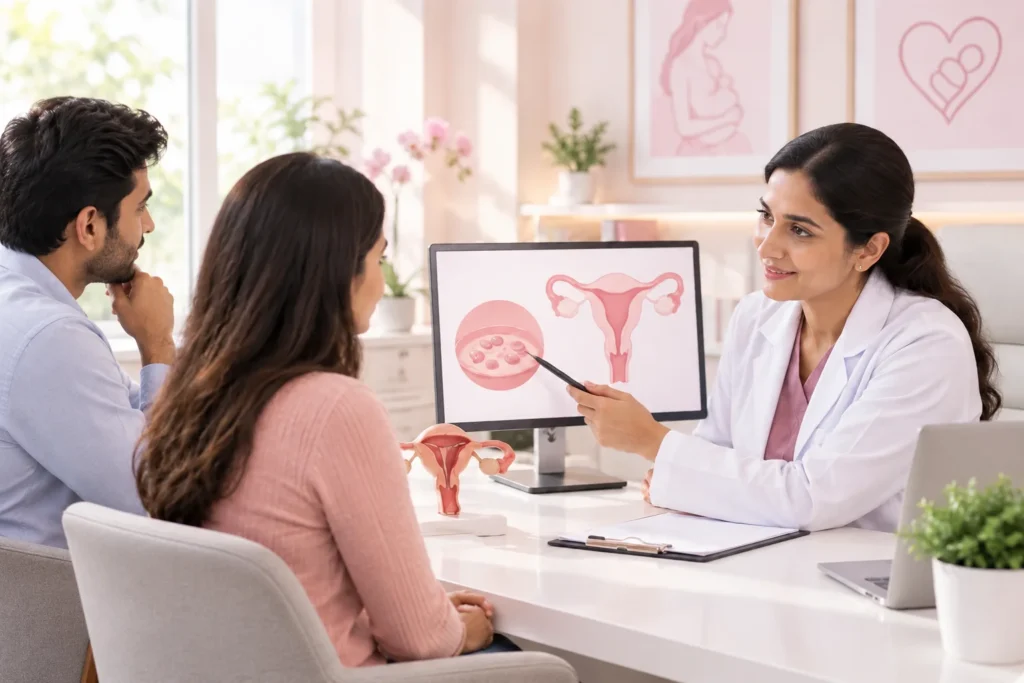

If you have been trying to conceive without success, one of the first questions you may have is: What tests are done during an infertility assessment?
There is no single fertility test that can explain every case of infertility. A proper infertility assessment looks at several factors, including ovulation, ovarian reserve, fallopian tubes, uterus and sperm health.
Importantly, fertility evaluation is not only about the woman. When a male partner is involved, both partners are generally evaluated because infertility can result from female factors, male factors or a combination of both.
The tests recommended can vary depending on your age, medical history, menstrual cycle, previous pregnancies, duration of trying to conceive and any known fertility problems.
When Should You Have an Infertility Assessment?
For women under 35, an infertility evaluation is generally recommended after 12 months of regular, unprotected intercourse without pregnancy.
For women aged 35 or older, evaluation is generally recommended after 6 months.
However, you may need an evaluation sooner if you have irregular or absent periods, known or suspected endometriosis, previous pelvic or tubal problems, suspected male-factor infertility, or other conditions that may affect fertility. Women over 40 may benefit from more immediate evaluation.
If you are concerned about your fertility, you do not necessarily have to wait for a specific number of months before discussing your situation with a fertility specialist.
What Happens During an Infertility Assessment?
An infertility assessment usually begins with a detailed discussion about your medical and reproductive history.
Your doctor may ask about:
- Menstrual cycle pattern
- Previous pregnancies or miscarriages
- How long you have been trying to conceive
- Previous fertility treatments
- Previous pelvic or abdominal surgeries
- Medical conditions
- Medications
- Family history
- Sexual and reproductive history
Your partner’s medical and fertility history may also be reviewed.
After this initial assessment, your doctor can decide which tests are actually needed.
1. Semen Analysis
A semen analysis is one of the most important initial tests when evaluating a couple for infertility.
It examines characteristics such as:
- Sperm concentration
- Sperm movement or motility
- Sperm morphology
- Semen volume
- Other semen characteristics
Male-factor infertility can contribute to difficulty conceiving, so evaluating the male partner at the same time as the female partner can avoid unnecessary delays. Current AUA/ASRM guidance recommends a reproductive history and one or more semen analyses as part of the initial male fertility evaluation.
If the semen analysis is abnormal, your doctor may recommend repeating it or arranging further evaluation depending on the findings.
2. Ovulation Assessment
Ovulation is important because pregnancy requires an egg to be released from the ovary.
Your doctor may assess ovulation through:
- Menstrual history
- Ovulation tracking
- Ultrasound monitoring
- Ovulation predictor kits
- Blood tests when clinically indicated
If your menstrual cycles are regular and fall within the usual range, additional testing to confirm ovulation may not always be necessary. If cycles are irregular or absent, further evaluation may be recommended to understand the cause.
Women with ovulation problems may sometimes benefit from ovulation induction treatment, depending on the underlying cause.
3. AMH Test
AMH stands for Anti-Müllerian Hormone.
It is commonly used as one marker of ovarian reserve, which refers broadly to the number of eggs remaining in the ovaries.
AMH can be useful when planning fertility treatment, particularly for estimating how the ovaries may respond to stimulation. However, AMH should not be interpreted as a standalone test of whether a woman can become pregnant naturally.
This is important because a low AMH result does not automatically mean that pregnancy is impossible.
4. Antral Follicle Count
Antral follicle count, commonly called AFC, is performed using a transvaginal ultrasound.
The doctor counts small follicles visible in the ovaries. AFC, along with AMH and other clinical information, can help assess ovarian reserve and may be particularly useful when planning fertility treatment.
AMH and AFC provide useful information, but they should always be interpreted alongside age, medical history and the overall fertility picture.
5. FSH and Other Hormone Tests
Depending on your menstrual pattern and clinical history, your doctor may recommend hormone testing.
This may include tests such as:
- FSH
- Estradiol
- TSH
- AMH
- Other hormones when clinically indicated
FSH and estradiol may be measured during the early part of the menstrual cycle when ovarian reserve assessment is required. TSH may also be checked when thyroid function could be relevant to fertility.
Not every woman needs every hormone test. Your doctor will decide based on your symptoms and medical history.
6. Pelvic Ultrasound
A pelvic or transvaginal ultrasound can provide important information about the reproductive organs.
It may help assess:
- Uterus
- Endometrial lining
- Ovaries
- Follicles
- Fibroids
- Ovarian cysts
- Other pelvic abnormalities
Ultrasound can also help with follicular monitoring when ovulation induction or other fertility treatment is being planned.
7. Fallopian Tube Tests
Open fallopian tubes are important for natural conception and treatments such as IUI.
A doctor may recommend a test to determine whether the tubes are open.
One commonly used test is HSG, or hysterosalpingography. It uses contrast material and imaging to assess the uterine cavity and whether the fallopian tubes are patent.
Another option in selected cases is sonohysterography, depending on the clinical situation. ASRM guidance recommends assessing tubal patency as part of infertility evaluation when appropriate.
If both fallopian tubes are blocked, the treatment approach may be different from that used for unexplained infertility or ovulation problems.
8. Uterine Assessment
The uterus can also be evaluated during an infertility assessment.
Your doctor may look for conditions such as:
- Fibroids
- Polyps
- Adhesions
- Structural abnormalities
- Other changes that could affect fertility or pregnancy
The type of assessment depends on your symptoms, medical history and initial ultrasound findings.
Not every woman needs an advanced uterine test.
9. Additional Tests When Needed
Sometimes the initial evaluation identifies a reason to investigate further.
Additional tests may be recommended depending on factors such as:
- Recurrent pregnancy loss
- Suspected genetic conditions
- Previous pelvic surgery
- Endometriosis
- Abnormal semen results
- Repeated failed fertility treatment
- Specific hormonal or medical conditions
This is why fertility testing should be personalised rather than treated as a fixed checklist.
ASRM specifically notes that several tests, including advanced sperm testing, laparoscopy, immunological testing and some other investigations, are not routinely recommended for every infertility evaluation without a clinical indication.
Why Do Both Partners Need Fertility Testing?
It is understandable to assume that fertility testing is mainly for women, but this is not the case.
Male factors can contribute to infertility, and both partners may have factors affecting conception.
Evaluating both partners at the same time can help identify the cause more efficiently and avoid unnecessary delays. A semen analysis is therefore commonly included early in the evaluation when a male partner is contributing to the pregnancy.
Does Everyone Need All These Infertility Tests?
No.
This is one of the most important things to understand.
You may not need every test mentioned in this article.
For example, a woman with regular cycles, a reassuring medical history and a normal initial evaluation may not require extensive hormonal or advanced testing.
Similarly, a man with a normal initial semen analysis may not need additional male fertility testing unless there is another reason to investigate.
Your fertility specialist should select tests based on your individual history and the questions that need to be answered.
What Happens After the Infertility Tests?
The purpose of testing is not simply to collect reports.
The goal is to understand why pregnancy has not occurred and which treatment, if any, is appropriate.
Depending on the findings, your doctor may recommend:
- Trying naturally for an appropriate period
- Ovulation induction
- Timed intercourse
- IUI
- IVF
- IVF with ICSI in selected cases
- Treatment of an underlying medical or reproductive condition
- Further evaluation before treatment
For example, if ovulation is the main concern, ovulation induction may be considered.
If IUI is appropriate based on the fertility findings, your doctor may discuss IUI treatment.
If there are blocked tubes, significant male-factor infertility, reduced ovarian reserve or other factors affecting the chances of IUI, IVF or ICSI may be considered depending on the overall situation.
The important point is that the test results should guide the treatment decision.
What Should You Bring to an Infertility Assessment?
If you are attending your first fertility appointment, it can be helpful to bring:
- Previous blood test reports
- Ultrasound reports
- Semen analysis reports
- Previous pregnancy records
- Previous fertility treatment records
- Details of your menstrual cycle
- List of current medications
- Previous surgery or medical records
Infertility Assessment in Bopal, Ahmedabad
If you are trying to conceive and need help understanding your fertility, a structured assessment can provide a clearer picture of what may be affecting conception.
Contact Dr. Ladu Dewasi provides fertility and gynaecology care at Mayflower Women’s Hospital in Bopal, Ahmedabad, with evaluation and treatment based on the individual fertility profile.
Depending on the findings, care may include infertility assessment, ovulation induction, IUI or IVF/ICSI.
Visit Dr. Ladu Dewasi’s clinic in Ahmedabad for personalized fertility and gynecology care.
About the Author
Dr. Ladu Dewasi is a Consultant Gynaecologist and Fertility Specialist at Mayflower Women’s Hospital, Ahmedabad, with over seven years of experience in reproductive medicine, gynaecology and obstetrics. She holds an MBBS and an MD in Anaesthesia, completed a fellowship at Mayflower Hospital, and has previously practised at CIMAR and Aster Hospital in Kochi. Her practice covers infertility assessment, ovulation induction, PCOS, IUI, IVF and ICSI, recurrent pregnancy loss and fertility preservation.
Frequently Asked Questions
What is the first test for infertility?
There is no single first test for every couple. A fertility assessment usually begins with medical history and evaluation of both partners, with semen analysis commonly included for the male partner.
Does infertility testing hurt?
Most initial tests, such as blood tests, ultrasound and semen analysis, are straightforward. Some procedures used to assess the fallopian tubes may cause temporary discomfort.
Is AMH test enough to check fertility?
No. AMH mainly provides information about ovarian reserve and should be interpreted with age, medical history and other fertility findings.
Do both partners need infertility testing?
Usually, both partners should be evaluated when applicable because infertility can involve male factors, female factors or both.
What happens if all fertility tests are normal?
Sometimes no specific cause is identified, which may be described as unexplained infertility. Treatment options can still be discussed based on age, duration of infertility and the overall fertility profile.
Medical Disclaimer
The information provided in this article is for general educational purposes only and should not be considered a substitute for professional medical advice, diagnosis or treatment. Fertility testing and treatment are individualised, and not every person requires every test discussed above. Please consult a qualified gynaecologist or fertility specialist for personalised advice.