Medically reviewed by Dr. Ladu Dewasi, MBBS, DGO,FRM (Fellowship in reproductive medicine), Consultant Gynaecologist and Infertility & IVF Specialist, Mayflower Women's Hospital, Bopal, Ahmedabad.
IVF with donor eggs uses eggs from a screened donor. The resulting embryo is placed in your uterus. It may help if your own eggs are few or low in quality. Common reasons include age over 40, early menopause and repeated IVF failure. Treatment usually takes a few months from your first visit to embryo transfer. Ask your healthcare provider if it suits you.
Contents What Is IVF With Donor Eggs? · Reasons and Eligibility · Tests and Preparation · Process and Treatment · Outlook · Risks and Self-Care
What Is IVF With Donor Eggs?
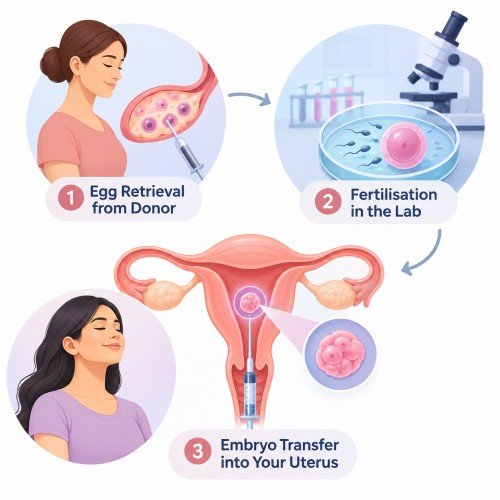
[IMAGE 1: Illustration of donor egg IVF showing egg retrieval, fertilisation in a lab and embryo transfer into the uterus. Use this as the alt text.] Donor egg IVF combines a donor’s eggs, sperm and your uterus.
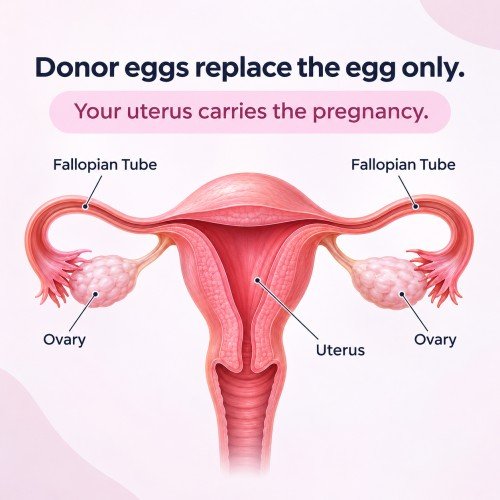
In vitro fertilisation (IVF) with donor eggs is a fertility treatment where the eggs come from another woman. Her eggs are collected from her ovaries and mixed with sperm in a lab. They grow into embryos over several days. A healthcare provider then places one embryo in your uterus (womb), and you carry the pregnancy even though the egg isn’t yours.
Egg quality and numbers fall with age, and some medical conditions speed this up. When your own eggs can’t lead to a pregnancy, eggs from a young, healthy donor may give you a better chance of success. Many people feel a mix of relief, sadness and hope about this choice. That’s completely normal, and talking it through with your doctor can help you work through it.
UK national data from 2018 showed live birth rates above 25% per embryo transferred with donor eggs, across all age groups. Your own results will depend on your health and your clinic. It’s never too late to ask questions and explore your options.
Types of donor egg cycles
Your clinic may offer more than one type of cycle, and your healthcare provider will suggest the best fit for you. Types could include:
- Fresh donor egg cycle: Your cycle is timed with the donor’s. Her eggs are fertilised after retrieval, and an embryo is transferred within days.
- Frozen embryo transfer (FET): Embryos are made from the donor’s eggs and frozen. You get your transfer in a later, planned cycle.
- Frozen donor egg cycle: Eggs frozen earlier by an egg bank are thawed and fertilised when you’re ready.
Donor egg IVF isn’t the same as intrauterine insemination (IUI) or surrogacy. In surrogacy, another woman carries the pregnancy. With donor egg IVF, you do. Frozen eggs rely on the same technology covered in our guide to freezing eggs and its risks.
Reasons and Eligibility
Who may need donor eggs
Donor eggs could be suggested if you have:
- Few remaining eggs (low ovarian reserve)
- Early menopause (premature ovarian insufficiency)
- Lower egg quality linked to age, often after 40
- Several failed IVF cycles with your own eggs
- Repeated pregnancy loss that may be linked to egg quality (recurrent miscarriage)
- Eggs that don’t fertilise
- Ovaries removed by surgery
- Ovary damage from chemotherapy or radiation
- A genetic condition, such as Turner syndrome
- A risk of passing a serious inherited condition to your baby
You won’t have all of these, and other fertility problems can look similar. Conditions like PCOS usually affect ovulation more than egg supply, so they rarely call for donor eggs. Needing donor eggs doesn’t mean you did anything wrong. Only a healthcare provider can confirm whether donor eggs are the right choice after proper testing and a careful talk about your history.
When do doctors first suggest donor eggs?
Often it comes after tests show low egg numbers or after unsuccessful IVF cycles. Some people hear about it at diagnosis, such as early menopause. Many others try simpler options first, such as ovulation induction or IUI. Check with your provider about all your options.
Eligibility and legal rules in India
In India, the Assisted Reproductive Technology (Regulation) Act, 2021 sets the rules. It covers ART clinics, egg banks, donors and the couples seeking treatment. Clinics must be registered, and egg donors come through registered banks. These rules aim to protect donors, parents and children born through treatment.
Donor and recipient requirements
Under the Act, egg donors must meet these conditions:
- Being between 23 and 35 years old
- Being ever-married, with at least one living child aged three or older
- Donating only once in her lifetime
- Having no more than seven eggs retrieved
- Giving eggs to only one couple
For couples, the Act sets age limits of 21 to 50 for the woman and 21 to 55 for the man. Couples must also be infertile. Courts and the government are still reviewing parts of these rules. Ask your clinic for the current position before you begin.
Tests and Preparation
Tests before you start
Before anything else, your healthcare provider needs a clear picture of your health and your uterus. This helps plan safe treatment and set realistic expectations. These infertility assessment tests could include:
- AMH blood test: Shows how many eggs you may have left.
- Pelvic ultrasound: Checks your uterus, lining and ovaries.
- Hysteroscopy: Lets your provider look inside the uterus with a thin camera.
- Hormone and infection blood tests: Check your general health and readiness for pregnancy.
- Semen analysis: Checks your partner’s sperm, if you’re using it.
Some clinics also run a trial cycle (mock cycle). It shows how your uterine lining responds to the medicines you’ll take.
Donor screening and matching
Every donor must pass health, infection and genetic screening before any of her eggs can be used. Your clinic or the egg bank handles this step, so you don’t need to arrange it yourself. You’ll also meet a counsellor to talk through consent, privacy and how you may feel about using donated eggs. Matching usually looks at things like blood group and physical features. What’s allowed can depend on the rules your clinic follows.
Process and Treatment
How does donor egg IVF work, step by step?
The goal is to make a healthy embryo and a uterus ready to receive it. Your clinic will walk you through the dates, scans and medicines, so nothing comes as a surprise. The order may change slightly from clinic to clinic. Steps could include:
- First consultation: You share your history, review your tests and discuss your treatment options. Our guide to the first fertility consultation lists what to bring.
- Choosing a donor: Your clinic matches you with a screened donor from a registered bank.
- Cycle planning: For a fresh cycle, your menstrual cycle is timed with the donor’s. Otherwise, embryos are frozen first.
- Donor stimulation: The donor takes fertility injections for about two weeks so several eggs grow.
- Preparing your lining: You take estrogen, then progesterone, to thicken your uterine lining.
- Egg retrieval: The donor has a short procedure under sedation to collect her eggs.
- Fertilisation: Eggs meet sperm in the lab, sometimes by ICSI. Embryos grow in an incubator.
- Embryo transfer: A thin tube places an embryo in your uterus. It’s quick and usually painless.
- Hormone support and testing: You continue medicines, then take a pregnancy test about two weeks later.
Timing differs from person to person. From your first consultation to embryo transfer, treatment often takes a few months, mostly because of testing, donor matching and cycle planning. Estrogen can be taken as tablets, patches or vaginal tablets. Progesterone is usually given vaginally or by injection. Many clinics prefer frozen transfers, because they give your body time to settle before the embryo goes in. Your provider may also suggest genetic testing of embryos.
When should I see my healthcare provider?
See a provider if you haven’t conceived after a year of trying. Go sooner if you know about early menopause or ovary surgery. After transfer, call your clinic right away for heavy bleeding, severe pelvic pain, fever or trouble breathing. Still unsure about the right treatment? Our article on how many IUI cycles to try before IVF may help.
Care at Dr. Ladu Dewasi’s Clinic
Outlook
What can I expect after embryo transfer?
You’ll wait about two weeks for a blood test, and your clinic will tell you the right day to take it. Testing too early at home may give a confusing result. Some spotting or mild cramps can happen. Most people stay on estrogen and progesterone for the first weeks of pregnancy, often until the placenta takes over around 10 weeks. If the test is positive, you’ll have an early scan to confirm the pregnancy. If it’s negative, your provider will review the cycle with you and talk about next steps, including using any frozen embryos.
How successful is donor egg IVF?
It depends on embryo quality, your uterine lining, your health and your clinic. HFEA data shows donor eggs give similar results across age groups. Many people need more than one cycle, and a cycle that doesn’t work isn’t a sign that you did anything wrong. Ask your clinic for its own live birth rates, not just pregnancy rates. When the donor is under 35 and the embryo looks healthy, experts usually advise transferring just one.
Risks and Self-Care
Donor egg IVF carries the usual IVF risks. These include medicine side effects, twin or triplet pregnancy, and miscarriage. Donors face their own risks, such as ovarian hyperstimulation, so clinics watch them closely. Your clinic will explain each risk before you give consent. Costs also vary widely, so ask for a written breakdown that covers donor fees, medicines, embryo freezing and transfers. Ways to lower your risks include:
- Choosing a registered clinic that shares its success rates openly
- Asking about single embryo transfer
- Taking medicines exactly as prescribed
- Going to every scan and blood test
- Taking folic acid if your provider advises it
- Asking for counselling if the process feels heavy
A note from Dr. Ladu Dewasi
We know this decision may come with grief as well as hope. You might need time to accept that your baby won’t share your genes. There’s no right way to feel. Many parents say the bond grows through pregnancy, birth and daily care.
Statistics can’t predict your story. Your healthcare provider is your best guide, and we’re here to answer your questions. Lean on your partner, family and friends. If you feel unsure about telling your child how they were born, a counsellor can help you plan that talk. Rest, eat well and be kind to yourself.
Experts You Can Trust Medically reviewed by Dr. Ladu Dewasi, MBBS, DGO,FRM (Fellowship in reproductive medicine), Consultant Gynaecologist and Infertility & IVF Specialist at Mayflower Women’s Hospital, Bopal, Ahmedabad. Learn more about Dr. Ladu Dewasi.
Visit Dr. Ladu Dewasi’s clinic in Ahmedabad for personalized fertility and gynecology care.
References This article is based on evidence-backed sources and is reviewed by a medical professional for accuracy.
- American Pregnancy Association. Donor eggs (https://americanpregnancy.org/infertility/donor-eggs/). Accessed 19/11/2026.
- American Society for Reproductive Medicine and Society for Assisted Reproductive Technology. Recipients of donor eggs: process, risks, consent. 2017 version (https://www.urmc.rochester.edu/getmedia/4109e8d1-27be-4c48-8240-ba38442f6c38/recipients-of-donor-eggs-form.pdf). Accessed 19/11/2026.
- Drishti IAS. ART Regulations: Impact on Cost and Conception Opportunities (https://www.drishtiias.com/daily-updates/daily-news-analysis/art-regulations-impact-on-cost-and-conception-opportunities/print_manually). 28/06/2023. Accessed 19/11/2026.
- Global Library of Women’s Medicine. Oocyte donation (https://glowm.com/resources/glowm/cd/pages/v5/v5c100.html). Accessed 19/11/2026.
- Human Fertilisation and Embryology Authority. Fertility treatment 2018: trends and figures (https://hfea.gov.uk/about-us/publications/research-and-data/fertility-treatment-2018-trends-and-figures/). Accessed 19/11/2026.
- Indian Fertility Society. IFS Newsletter, July 2025 (https://indianfertilitysociety.org/wp-content/uploads/2025/07/IFSNewsletter-July-2025.pdf). Accessed 19/11/2026.
- Paulson R. Hormonal induction. ASRM Academy (https://prod.asrm.org/asrm-academy/asrm-academy-on-the-go/asrmed-talks/hormonal-induction/). Accessed 19/11/2026.
- University of Rochester Medical Center, Strong Fertility Center. Donor eggs (https://www.urmc.rochester.edu/strong-fertility-center/services/infertility/infertility-treatment-options/donor-eggs). Accessed 19/11/2026.
Medical disclaimer: This article is for general information and education. It does not replace a consultation, diagnosis or treatment from a qualified doctor. Every person’s health is different, so please speak with Dr. Ladu Dewasi or your own healthcare provider about your symptoms and treatment options. If you have a medical emergency, call your local emergency number or visit the nearest hospital right away.
Care at Dr. Ladu Dewasi’s Clinic We know this journey can feel overwhelming, and you don’t have to take it alone. Call or WhatsApp +91 99097 16716, Monday to Saturday, 10:00 am to 7:00 pm, at Mayflower Women’s Hospital, Bopal, Ahmedabad.